
1. Executive Summary
The global packaging industry is evolving faster than ever. Driven by surging demand for kraft liner and recycled containerboard, paper mills worldwide are under sustained pressure to increase production, improve quality, reduce energy consumption, and eliminate unplanned downtime. The mills that will lead the next decade of growth are not those that simply add more machines, but those that operate their existing assets with greater intelligence.
This case study examines the structural shift underway in modern kraft paper manufacturing: the transition from manually supervised, reactive production environments to smart, sensor-driven, AI-assisted mills built on Industry 4.0 principles. Drawing on field experience from JMC Paper Tech’s deployments across India and Latin America — including the greenfield Balaji JMC Paper Mill in Ciudad Juárez, Mexico, and the MillMind™ AI intelligence platform — this study quantifies the operational and commercial impact of smart automation across stock preparation, the paper machine, energy systems, and maintenance.
The findings are consistent across deployments. Mills that adopt smart automation typically see GSM variability fall by 40 to 60 percent, unplanned downtime drop by 25 to 35 percent, specific energy consumption decline by 8 to 15 percent, and overall equipment effectiveness (OEE) climb by 10 to 18 percentage points within the first 12 to 18 months. More importantly, the operating culture of the mill shifts: decisions become data-driven, maintenance becomes predictive, and quality becomes engineered rather than inspected.
Key Takeaways
- Smart automation is no longer a competitive advantage in kraft paper manufacturing — it is fast becoming a baseline operational requirement.
- The largest gains come not from any single technology, but from integrating sensors, control logic, predictive analytics, and centralized supervision into one connected ecosystem.
- Greenfield mills that build automation into the original design realize ROI faster than brownfield retrofits, but both paths deliver strong commercial returns.
- AI-driven platforms such as MillMind™ are now extending automation beyond the DCS layer into production planning, energy intelligence, and predictive quality assurance.
2. The Challenge: Why Conventional Mills Are Hitting a Ceiling
For decades, kraft paper mills have been operated through a combination of experienced operator judgment, periodic laboratory testing, and pneumatic or basic PLC-based control. This model delivered acceptable results at moderate machine speeds and at production scales of 50 to 150 tons per day. But as modern kraft and recycled containerboard machines have pushed past 600 m/min and 200+ tons per day per line, the limitations of conventional operating practice have become difficult to ignore.
2.1 The Cost of Manual Operation
The most visible symptom is GSM variation. Frequent fluctuations in basis weight, moisture profile, and formation quality create instability throughout the production process. In high-speed kraft paper machines, even small inconsistencies translate directly into production losses, customer complaints, and increased waste generation. When a 250 GSM test liner drifts by ±8 GSM, the mill is either giving away fiber for free or producing off-spec reels — both outcomes destroy margin.
Beyond GSM, conventional mills consistently struggle with a recognizable cluster of operational pain points:
- Delayed response to process fluctuations — operators react after the upset has already propagated.
- Excessive energy consumption from dryers, vacuum systems, and refining circuits running at fixed setpoints.
- Unplanned machine downtime caused by undetected wear in bearings, gearboxes, and rolls.
- Higher fiber losses through poorly tuned save-all and white water circuits.
- Inconsistent reel quality, particularly in formation, profile, and edge moisture.
- Heavy maintenance dependency, with critical equipment failures forcing emergency shutdowns.
- Limited production visibility — management often sees yesterday’s numbers, not today’s reality.
2.2 The Compounding Problem
These issues do not exist in isolation. A small upset in stock consistency causes formation defects, which trigger sheet breaks, which create unplanned downtime, which delays maintenance, which accelerates equipment wear, which causes the next upset. Without continuous monitoring and intelligent control, mills end up firefighting symptoms rather than addressing root causes.
As production capacities increase and customer specifications tighten — particularly in food-contact, export-grade, and premium liner segments — mills require faster and more accurate decision-making systems than human operators alone can provide. This is the point at which smart automation transitions from a discretionary investment to an operational necessity.
“Even the most skilled operator cannot watch fifty variables at once, twenty-four hours a day, three hundred and sixty-five days a year. Smart automation is not a replacement for our people — it is what allows our people to make better decisions, faster.”
— Production leadership perspective, recycled kraft mill, North America
3. What Smart Automation Means in a Modern Paper Mill
Smart automation is often confused with simply installing a DCS or a few extra sensors. In practice, it is something significantly broader: the integration of intelligent control systems, distributed sensors, real-time monitoring, predictive analytics, and automated process optimization throughout the entire paper manufacturing process — from raw material reception to reel shipment.
In a smart mill, control loops do not just maintain setpoints; they continuously analyze production conditions and make precise adjustments in real time. Quality is not just measured at the reel; it is predicted upstream and corrected before it goes out of spec. Maintenance is not just scheduled; it is anticipated based on vibration, temperature, and load signatures. The result is a mill that is more stable, more consistent, and more reliable — without requiring a larger workforce.
3.1 The Building Blocks
A modern smart kraft paper mill is built from seven interconnected layers, each of which delivers measurable value on its own and multiplies the value of the others when integrated:
| Layer | Function |
| Field Instrumentation | Distributed sensors measuring consistency, flow, pressure, temperature, vibration, moisture, GSM, vacuum, and motor load across the mill. |
| Control Layer (DCS/PLC) | Real-time process control with closed-loop regulation of consistency, basis weight, moisture profile, and machine speed. |
| QCS & Scanners | Quality Control System with cross-direction scanners for GSM, moisture, caliper, and ash — feeding back into headbox and steam control. |
| Data Historians | High-resolution time-series storage capturing every tag, every second, for trend analysis and root-cause investigation. |
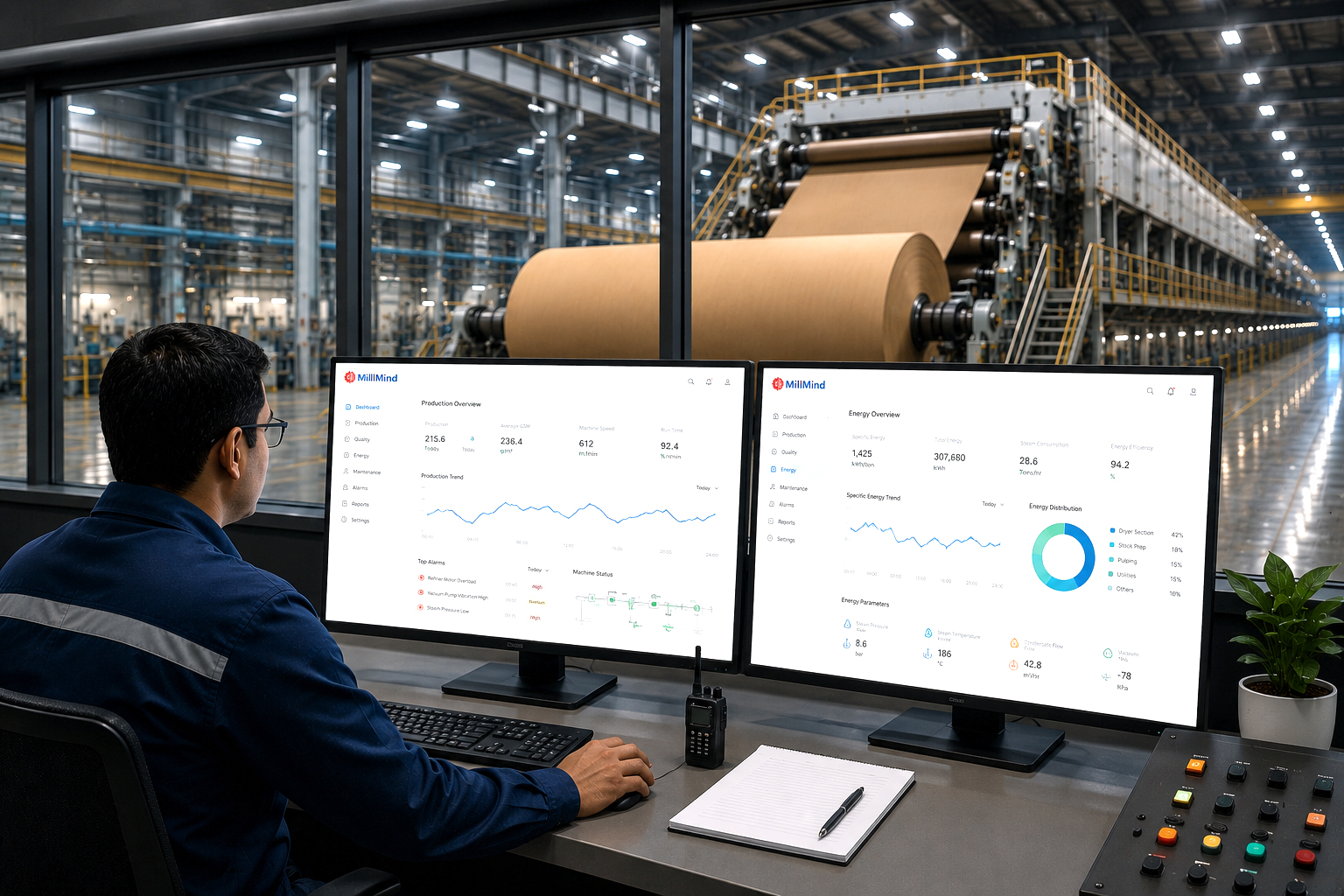
| Analytics Platform | AI and statistical models that detect anomalies, predict failures, and recommend setpoint adjustments — the MillMind™ layer. |
| Visualization & MES | Centralized dashboards for production, quality, energy, OEE, and downtime — accessible to operators, supervisors, and management. |
| Integration Bus | MQTT/OPC-UA backbone connecting all layers, ensuring data flows seamlessly from sensor to executive dashboard. |
The defining characteristic of a smart mill is not the presence of any one of these layers, but the seamless flow of information between them. A vibration signal on a refiner motor at 3:00 a.m. should be visible on the maintenance dashboard, correlated with the production schedule, and ready to inform the morning meeting — automatically, without anyone having to ask.
4. Automation in Stock Preparation
The stock preparation section plays a disproportionate role in determining paper quality and machine performance. Variations in pulp consistency, contaminant removal efficiency, or flow stability can affect the entire downstream production line. In recycled kraft manufacturing — where the raw material is OCC (Old Corrugated Containers) of variable quality — this section becomes even more critical.
4.1 The Recycled Fiber Challenge
OCC bales arriving at a recycled kraft mill vary widely in fiber quality, moisture content, contamination level, and ash. A bale sourced from a clean industrial generator behaves very differently from a curbside-collected mixed bale. Without automated control, this variability propagates straight into the headbox, causing formation problems, strength variation, and sheet breaks.
Smart automation addresses this variability at every stage of the stock prep line:
- Consistent pulp density control through closed-loop consistency transmitters and dilution valves.
- Automated chemical dosing for retention aids, sizing, dry strength agents, and biocides — based on real-time flow and consistency rather than fixed pump speeds.
- Intelligent contaminant separation with automated reject monitoring on HD cleaners, screens, and through-flow cleaners.
- Stable flow regulation between machine chest, blend chest, and headbox, eliminating consistency swings that cause GSM drift.
- Reduced fiber losses through automated save-all optimization and white water consistency monitoring.
- Improved recycled fiber recovery via load-sensitive refining control that adapts to incoming furnish quality.
4.2 Operational Impact
Mills that have automated their stock preparation section consistently report a measurable reduction in headbox consistency variation — typically from ±0.05% on a manual line to ±0.015% on an automated line. This single improvement cascades into better formation, lower sheet break frequency, and tighter GSM control on the reel.
70% | Reduction in headbox consistency variation after stock-prep automation upgrade Typical performance improvement on recycled kraft lines |
5. Machine Stability and GSM Consistency
One of the most commercially significant advantages of smart automation is improved machine stability. Modern kraft paper machines operate at speeds where even minor process variations can affect paper quality, fiber yield, and customer satisfaction. The economics of stability are stark: every additional sheet break per shift, every percentage point of off-spec production, and every kilogram of fiber given away through overweight reels eats directly into mill profitability.
5.1 The Variables That Matter
Smart monitoring systems continuously track a tightly correlated set of variables, each of which influences final paper quality:
| Variable | What It Controls | Typical Control Strategy |
| GSM Profile | Basis weight uniformity across machine width | QCS scanner + slice lip actuators + headbox dilution |
| Moisture Profile | CD/MD moisture variation, dryer load | IR moisture sensors + steam pressure control + rewet showers |
| Machine Speed | Production rate, draw, sheet tension | Sectional drive control with master speed reference |
| Vacuum Pressure | Dewatering efficiency on wire and press | VFD-controlled vacuum pumps with pressure feedback |
| Dryer Performance | Final moisture, energy consumption | Cascaded steam pressure groups + condensate recovery |
| Reel Tension | Reel hardness, telescoping prevention | Load-cell feedback + nip pressure control |
| Headbox Flow | Jet-to-wire ratio, formation quality | Mag-flow meters + fan pump VFD + slice opening control |
5.2 Commercial Outcome
Real-time adjustments help maintain stable operating conditions throughout the machine. The result is fewer sheet breaks, better formation quality, and minimized production interruptions. Consistent GSM control also strengthens customer confidence — especially for packaging applications such as testliner and fluting medium, where strength and uniformity are critical to box performance.
For a 200 TPD recycled kraft line producing testliner at $480/MT, reducing GSM standard deviation from 4.5 GSM to 1.8 GSM on a 200 GSM grade allows the mill to safely operate at a lower nominal target — typically saving 1.5 to 2.5 GSM of fiber per reel. On 60,000 MT annual production, that translates to fiber savings of $200,000 to $350,000 per year, with no capital investment beyond the automation itself.
6. Energy Efficiency Through Intelligent Process Control
Energy cost is one of the largest operational expenses in paper manufacturing, typically accounting for 18 to 28 percent of total production cost in recycled kraft mills. Steam systems, vacuum pumps, dryers, motors, refiners, and water circulation systems consume significant amounts of energy every day — and most of that consumption is, in conventional mills, only loosely correlated with actual production needs.
Smart automation transforms energy from a fixed overhead into a managed variable. By continuously monitoring machine conditions and adjusting operations for maximum efficiency, automated systems can deliver meaningful reductions across every major energy consumer in the mill:
- Steam consumption optimization through cascaded dryer group control and condensate recovery.
- Dryer section efficiency via differential pressure monitoring and pocket ventilation tuning.
- Vacuum system performance using VFD-driven pumps that match actual dewatering demand.
- Motor load balancing across refiners, pumps, and fans with real-time power monitoring.
- Water recovery systems with automated white water and clarifier loop management.
- Heat utilization efficiency through waste heat recovery on dryer hoods and stack gases.
6.1 Energy Intelligence in Action
Modern energy-efficient paper mills now monitor production output against energy consumption in real time. The key metric is specific energy consumption (SEC) — kWh per ton of paper produced — and intelligent dashboards allow operators to see this number live, not at month-end.
When SEC begins drifting upward, operators receive an alert and can identify the cause before significant losses accumulate. A typical example: a partially fouled dryer cylinder causes steam consumption to rise by 4 percent on the affected group. In a conventional mill, this might go unnoticed for weeks. In an automated mill, the SEC dashboard flags it within hours, and a targeted cleaning is scheduled before efficiency degrades further.
8–15% | Typical specific energy consumption reduction after full energy intelligence deployment Achievable within 12 months on recycled kraft lines, with no major capital equipment changes |
7. Predictive Maintenance: From Reactive to Proactive
Unexpected downtime can severely impact paper mill productivity. A single unplanned shutdown on a 200 TPD line, lasting 8 hours, costs the mill approximately 67 tons of lost production — at $480/MT, that is over $32,000 of revenue gone in a single shift, before accounting for repair costs and customer delivery impact.
Traditional maintenance systems rely on periodic inspection or reactive repairs after breakdowns occur. Predictive maintenance changes this approach completely. Smart monitoring systems use sensors and performance analytics to detect early signs of equipment wear or operational abnormalities. Operators and maintenance teams receive alerts before critical failures happen, allowing planned interventions during scheduled shutdowns rather than emergency repairs in the middle of production runs.
7.1 What Predictive Maintenance Monitors
In a fully instrumented mill, predictive maintenance systems continuously track:
- Bearing temperatures across all major motors, gearboxes, and rolls.
- Vibration levels on press section rolls, refiner discs, drive motors, and fan pumps.
- Pump efficiency through flow-versus-power curves that detect cavitation and wear.
- Motor performance via current signature analysis and insulation resistance trends.
- Roll alignment using nip pressure profiles and load cell feedback.
- Vacuum fluctuations indicating wire or felt wear, plugged piping, or pump degradation.
- Lubrication conditions monitored through oil temperature, pressure, and particle counts.
7.2 The Commercial Case
Mills that have implemented predictive maintenance report significant reductions across every cost category that flows from equipment failure:
| Cost Category | Typical Reduction |
| Emergency shutdowns | 40 – 60% |
| Collateral spare part damage | 30 – 50% |
| Annual repair costs | 20 – 30% |
| Production losses from unplanned downtime | 25 – 35% |
| Maintenance overtime hours | 15 – 25% |
| Average equipment life extension | 15 – 25% |
Beyond the direct savings, predictive maintenance changes the working environment of the maintenance department itself. Engineers spend less time on emergency call-outs and more time on planned improvement work — a shift that improves both technical outcomes and workforce retention.
8. Data-Driven Decision Making
Perhaps the most transformative aspect of Industry 4.0 in paper manufacturing is data visibility. Modern automation systems generate large amounts of operational data, and when this data is properly captured, contextualized, and presented, it fundamentally changes how mills are managed.
Instead of depending on manual observation, end-of-shift logs, and monthly reports, management teams can now analyze in real time:
- Production efficiency trends across shifts, days, weeks, and grades.
- Quality consistency reports broken down by reel, grade, and customer specification.
- Downtime analysis categorized by root cause, equipment, and shift.
- Energy consumption patterns mapped against production and ambient conditions.
- Operator performance benchmarked across shifts and individuals.
- Machine utilization rates and OEE components (availability, performance, quality).
- Production bottlenecks identified by section throughput analysis.
8.1 From Information to Insight
Raw data alone does not improve mill performance. The transformation occurs when data is turned into insight — when patterns emerge that human observation alone could not detect. Examples seen consistently in deployments include identifying that a specific OCC supplier’s bales correlate with 18% higher refining energy, that night shift sheet break frequency is 32% higher than day shift due to a single operator’s setpoint preferences, and that maintenance work orders on the press section spike predictably every 14 days due to a felt wear pattern.
None of these insights are visible in conventional reporting. All of them, once identified, become opportunities for measurable improvement.
“We used to argue about what happened on the previous shift. Now we look at the dashboard together and we know. The conversation has moved from ‘who is responsible’ to ‘what should we change’.”
— Operations manager, recycled kraft mill
9. Automation as a Sustainability Lever
Sustainability has moved from a corporate social responsibility topic to a procurement requirement. Major box plant customers, brand owners, and retailers increasingly demand quantifiable evidence of reduced water use, lower energy intensity, and responsible recycled fiber utilization from their paper suppliers. Smart automation is one of the most direct levers available to mills that need to deliver on these commitments without sacrificing competitiveness.
Automation directly supports sustainable manufacturing across six measurable dimensions:
- Fiber recovery efficiency — minimizing fiber loss to effluent through automated save-all and clarifier control.
- Water conservation — closing white water loops and optimizing fresh water makeup.
- Energy utilization — reducing kWh and steam per ton through real-time SEC monitoring.
- Waste reduction — lowering broke generation through stability and fewer sheet breaks.
- Production stability — reducing rejected and downgraded reels.
- Recycled fiber processing — adapting refining and cleaning to incoming OCC quality.
Automated systems also reduce unnecessary chemical usage and improve process precision, creating a more environmentally efficient production cycle. For recycled kraft liner production, intelligent process control allows mills to achieve premium quality from recovered fibers while minimizing operational waste — a critical capability as the global containerboard industry shifts further toward 100% recycled furnish.
10. Case Reference: Balaji JMC Paper Mill
The principles described in this study are not theoretical. They are being applied today at Balaji JMC Paper Mill, a greenfield recycled-fiber containerboard mill established in Ciudad Juárez, Chihuahua, Mexico, by the Patel family in partnership with JMC Paper Tech Private Limited (Ahmedabad, India). The mill is designed to produce testliner (L100–L240 GSM), fluting medium (M100–M240 GSM), and core board (C200–C400 GSM) from 100% OCC furnish, targeting an annual production of 58,500 metric tons.
10.1 Smart Automation by Design
Because Balaji JMC was conceived as a greenfield facility, smart automation was designed into the mill from day one rather than retrofitted later. This design philosophy delivered several immediate advantages:
- Full DCS coverage across stock preparation, approach flow, paper machine, and finishing, with no manual control islands.
- QCS scanners and CD profile actuators specified at the headbox stage rather than as an afterthought.
- Energy submetering on every major drive, pump, and steam header — enabling SEC tracking from the first production day.
- Vibration and temperature monitoring on all critical rotating equipment, with the data flowing directly into a centralized historian.
- Bilingual (English/Spanish) HMI and operator training, supporting the cross-border workforce.
10.2 MillMind™: The Intelligence Layer
Sitting on top of the conventional DCS and QCS layers, Balaji JMC deploys MillMind™ — an AI-driven paper mill intelligence platform co-developed by JMC Paper Tech. MillMind™ provides modular coverage across production, quality, energy, maintenance, and HR, all unified under a single web-based interface accessible to operators on the shop floor and to management remotely.
The MillMind™ architecture is purpose-built for industrial scale: an MQTT broker ingests high-frequency sensor data from across the mill, a time-series database stores historical trends with millisecond resolution, and a SQL Server backend handles transactional production data. Machine learning models for predictive quality, anomaly detection, and energy forecasting run on this foundation, with results surfaced through dashboards built in React and Shadcn/UI with Recharts visualization.
10.3 Early Operating Results
By February 2026, Balaji JMC produced 2,431 metric tons of containerboard with approximately 93.5% sellable output — a yield that reflects the stability advantages of designing automation in from the start. The mill continues to ramp toward its full design capacity, with smart automation enabling the team to manage the ramp-up curve far more predictably than a conventionally instrumented mill of the same vintage would allow.
93.5% | Sellable output ratio achieved in February 2026 under full smart-automation operation Greenfield recycled kraft mill — Balaji JMC, Ciudad Juárez, Mexico |
11. Quantified Benefits: A Composite View
Drawing on industry benchmarks and JMC Paper Tech’s field experience, the following table summarizes the typical performance improvements that recycled kraft paper mills can expect from a fully deployed smart automation program. Ranges reflect the variation between brownfield retrofits and greenfield installations, between small and large production lines, and between mills at different starting maturity levels.
| Performance Indicator | Typical Improvement | Primary Driver |
| GSM standard deviation | 40 – 60% reduction | QCS + headbox dilution control |
| Moisture profile variation (2σ) | 30 – 50% reduction | CD moisture control + dryer optimization |
| Sheet breaks per day | 25 – 40% reduction | Stock prep stability + tension control |
| Unplanned downtime hours | 25 – 35% reduction | Predictive maintenance |
| Specific energy consumption (SEC) | 8 – 15% reduction | Energy intelligence + VFD control |
| Fiber loss to effluent | 20 – 35% reduction | Save-all and white water automation |
| Overall Equipment Effectiveness (OEE) | 10 – 18 pts increase | Combined availability + performance + quality |
| Specific chemical consumption | 10 – 20% reduction | Automated dosing on flow + consistency |
| Customer complaint rate | 30 – 50% reduction | Quality consistency + reel traceability |
| Typical payback period | 12 – 24 months | Combined yield, energy, and downtime gains |
These numbers are not exotic. They are the consistent, repeatable outcomes of integrating sensors, control logic, analytics, and operator workflows into a connected mill operating environment. The mills that achieve the upper end of each range share a common characteristic: they treat smart automation as a long-term operating philosophy, not a one-time project.
12. The Future of Smart Kraft Paper Manufacturing
The trajectory of paper manufacturing over the next decade will be defined by intelligent systems, deeper automation, and increasingly connected production environments. Several developments are already moving from pilot to mainstream deployment in leading mills worldwide:
- AI-assisted production monitoring with anomaly detection across thousands of process tags.
- Remote machine diagnostics enabling OEM specialists to support mills globally without travel.
- Cloud-based production analysis providing benchmarking across multiple sites and grades.
- Centralized operational control rooms managing multiple machines or even multiple mills.
- Automated quality prediction that flags off-spec risk hours before it occurs on the reel.
- Smart maintenance planning that schedules interventions based on equipment health rather than the calendar.
- Integrated mill management systems unifying ERP, MES, DCS, and quality data into a single source of truth.
As global competition increases — particularly across the North American containerboard market, where recycled kraft producers in the US, Mexico, and emerging Latin American capacity are competing for the same box plant customers — mills that invest in smart automation will be better positioned to achieve higher efficiency, stable product quality, and long-term profitability. The transition toward intelligent manufacturing is no longer optional for ambitious paper producers; it is becoming an operational baseline.
13. Conclusion
Modern kraft paper manufacturing is no longer driven by machinery alone. It is driven by intelligence, precision, and real-time operational control. Smart automation allows paper mills to improve productivity, reduce downtime, optimize energy consumption, and maintain consistent paper quality in markets that grow more competitive with each year.
As the global packaging industry continues to grow — propelled by e-commerce, sustainable packaging substitution, and demand for recycled-content containerboard — the requirement for stable, efficient, and sustainable paper production will only intensify. Mills that adopt intelligent automation technologies today are not merely modernizing; they are preparing themselves for a structurally different competitive environment over the next decade.
With more than 24 years of engineering experience, deep field expertise in recycled kraft containerboard manufacturing, and a proprietary mill intelligence platform in MillMind™, JMC Paper Tech Pvt. Ltd. continues to support the evolution of smarter, more efficient paper manufacturing systems for clients across India, Mexico, and the global paper industry.
About JMC Paper Tech Pvt. Ltd.
Headquartered in Ahmedabad, Gujarat, India, JMC Paper Tech Private Limited is a paper machinery manufacturer and exporter with more than 24 years of experience designing, building, and commissioning kraft and recycled containerboard production lines for clients across South Asia, Africa, the Middle East, and Latin America. The company’s expertise spans complete mill engineering, stock preparation systems, paper machine rebuilds, and — through its MillMind™ platform — AI-driven mill intelligence and Industry 4.0 deployments.
JMC Paper Tech operates Balaji JMC Paper Mill in Ciudad Juárez, Mexico, as a flagship reference plant for recycled kraft containerboard production in the North American market.
| Website | jmcmachines.com |
| Enquiries | info@jmcengineers.com |
| Headquarters | Ahmedabad, Gujarat, India |
| Mexico Operations | Balaji JMC Paper Mill, Ciudad Juárez, Chihuahua, Mexico |