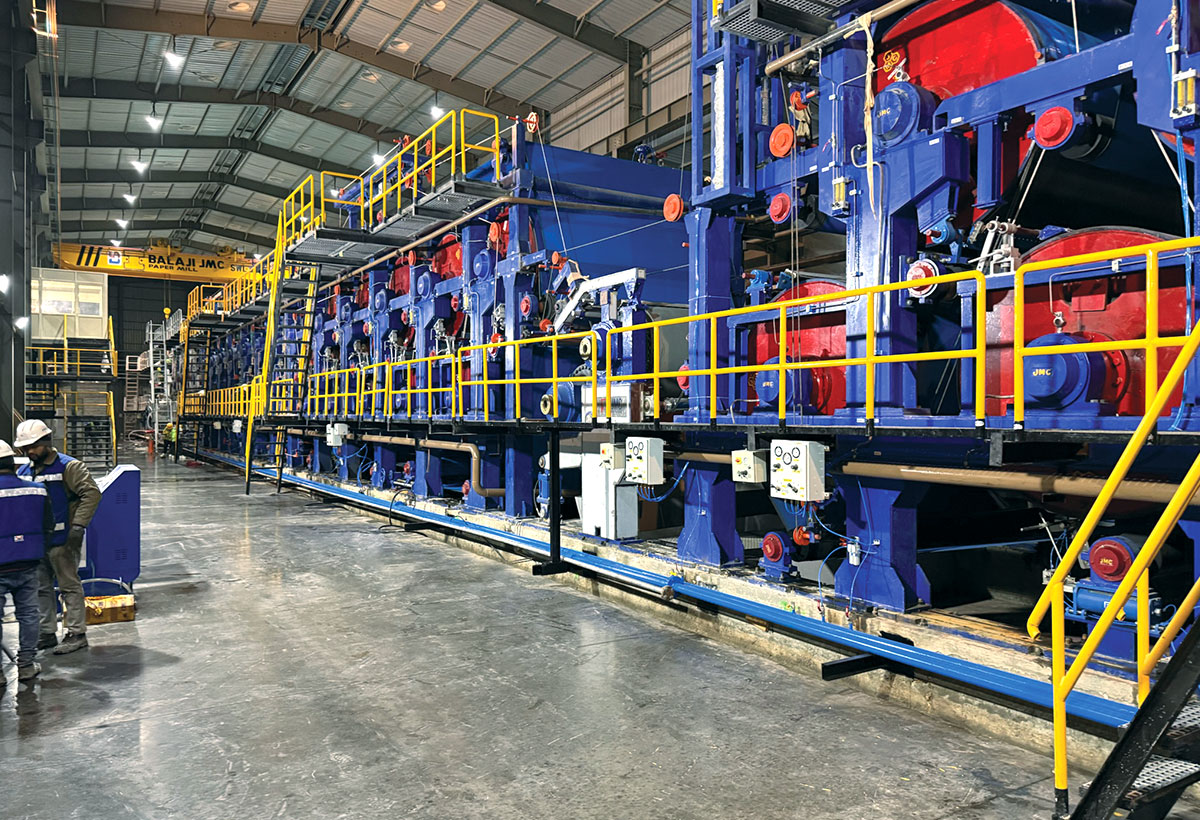
Machine designed, supplied, and commissioned by JMC Paper Tech Pvt. Ltd., Ahmedabad, India. Reference installation: Balaji JMC Paper Mill S. de R.L. de C.V., Ciudad Juárez, Chihuahua, México — a greenfield recycled-fiber containerboard mill operating on 100% OCC furnish.
1. Executive Summary
On 12 May 2026, the JMC-built double wire kraft paper machine produced 192.99 MT of saleable containerboard across three shifts of continuous operation, consuming 194.00 m³ of fresh water and 51,800 kWh of electrical power. This translates to a specific water consumption of approximately 1.01 m³ per tonne of paper and a specific power consumption of approximately 268 kWh per tonne — held consistently across all three shifts.
These figures place the machine far ahead of typical recycled-fiber containerboard operations, which commonly consume 3–8 m³ of water and 450–600 kWh of power per tonne. On this operating day, the machine ran 66–87% below industry water benchmarks and 40–55% below industry power benchmarks, while producing roughly 9% above the mill’s nameplate-equivalent daily rate of ~177 MT/day.
Headline Metric | 12 May 2026 | Industry Range | Advantage |
Specific water consumption (m³/MT) | 1.01 | 3.0 – 8.0 | 66–87% lower |
Specific power consumption (kWh/MT) | 268.4 | 450 – 600 | 40–55% lower |
Machine production (MT) | 192.99 | ~177 nameplate/day | +9% above rate |
Rewinder throughput vs. machine (%) | 98.83 | — | Low broke / loss |
2. Background: The Machine and the Mill
JMC Paper Tech Pvt. Ltd. designed, manufactured, supplied, erected, and commissioned the complete production line at Balaji JMC Paper Mill, a greenfield containerboard mill established in 2025 in Ciudad Juárez, México. The mill operates on 100% recycled OCC (old corrugated containers) furnish and produces Test Liner (L100–L240 GSM), Fluting Medium (M100–M240 GSM), and Core Board (C200–C400 GSM) for the Southwest United States and Mexican domestic markets, with a nameplate capacity of 58,500 MT per year.
Fiber processing is handled by two complete stock preparation streets built around JMC’s FIBER PRO pulping technology — the FIBER PRO Smart LCD Pulper and the FIBER PRO Smart Thermo Pulper — feeding a double wire kraft paper machine equipped with three heavy-duty Jumbo presses, steel dryer sections, a size press, a calender, and a high-speed rewinder. The twin-street configuration allows liner and medium furnishes to be prepared independently and switched without disturbing machine runnability.
2.1 Installed Line Configuration
Section | JMC-Supplied Equipment |
Pulping | FIBER PRO Smart LCD Pulper · FIBER PRO Smart Thermo Pulper |
Stock preparation | Two complete streets — independent cleaning, screening, and refining lines for liner and medium furnish |
Forming | Double wire kraft paper machine |
Pressing | Three heavy-duty Jumbo presses |
Drying | Steel dryer sections |
Surface treatment | Size press |
Finishing | Calender · High-speed rewinder |
Because JMC is both the machinery builder and an operating stakeholder in the mill, the installation serves as a live, fully instrumented reference site. The consumption figures in this case study are actual metered daily values from mill operations — not test-bench results or design-basis projections.
3. Production Performance — Three-Shift Report
The mill operates a continuous three-shift pattern. On 12 May 2026, all three shifts produced, with output balanced across the day. All figures are in metric tonnes (MT).
3.1 Machine Production by Shift
Parameter | Shift 1 | Shift 2 | Shift 3 | Day Total |
Machine production (MT) | 64.20 | 65.84 | 62.95 | 192.99 |
Shift output ranged within a narrow band of 62.95–65.84 MT — a spread of less than 5% — reflecting stable machine runnability and consistent operating discipline across crews.
3.2 Grade-Wise Production by Shift
Parameter | Shift 1 | Shift 2 | Shift 3 | Day Total |
Liner (MT) | 64.20 | 65.84 | 51.05 | 181.09 |
Medium (MT) | 0.00 | 0.00 | 11.90 | 11.90 |
Core Board (MT) | 0.00 | 0.00 | 0.00 | 0.00 |
Total (MT) | 64.20 | 65.84 | 62.95 | 192.99 |
Liner accounted for 93.8% of the day’s output and medium 6.2%. The liner-to-medium grade change was executed during Shift 3 with no loss of shift output relative to the day’s average — made possible by the twin stock preparation streets, which allowed the medium furnish to be prepared and conditioned in parallel while liner production continued. No core board was scheduled.
3.3 Rewinder Production by Shift
Parameter | Shift 1 | Shift 2 | Shift 3 | Day Total |
Rewinder output (MT) | 63.45 | 65.10 | 62.18 | 190.73 |
High-speed rewinder throughput of 190.73 MT against machine production of 192.99 MT represents a conversion ratio of 98.83%, sustained across all three shifts — indicating very low broke generation and trim loss at the finishing end. This matters for resource efficiency: every tonne of broke re-pulped costs water and power a second time.
4. Water Consumption Analysis
4.1 Daily and Shift-Wise Performance
Parameter | Shift 1 | Shift 2 | Shift 3 | Day Total |
Production (MT) | 64.20 | 65.84 | 62.95 | 192.99 |
Water consumed (m³) | 64.50 | 66.20 | 63.30 | 194.00 |
Water intensity (m³/MT) | 1.00 | 1.01 | 1.01 | 1.01 |
Specific water consumption held at 1.00–1.01 m³/MT in every shift — the closed water loop performs identically regardless of crew or time of day, including through the Shift 3 grade change. Typical recycled containerboard operations consume 3–8 m³/MT.
At a conservative industry benchmark of 3 m³/MT, producing the same 192.99 MT would have required approximately 579 m³ of fresh water — 385 m³ more than the mill actually used. Against the upper end of the range (8 m³/MT), the avoided intake is roughly 1,350 m³ in a single day. Annualized over approximately 330 operating days at similar production, this corresponds to 127,000–445,000 m³ of fresh water saved per year — a decisive advantage in the Chihuahuan desert, where water rights and availability are a genuine constraint on industrial operations.
4.2 How the Machine Design Achieves It
- FIBER PRO Smart pulping: the Smart LCD Pulper and Smart Thermo Pulper slush OCC at controlled consistency with low dilution demand and high fiber yield, so less water enters the system per tonne of furnish from the very first process step.
- Closed white-water circuit: machine white water is recovered and cascaded back through stock dilution in both preparation streets, eliminating most fresh-water demand at the wet end.
- Twin-street water management: separate liner and medium streets each run on an optimized loop, avoiding the loop flushing that single-street mills require at every grade change.
- High-efficiency fiber recovery (save-all) systems that clean and recirculate process water while returning fiber to the furnish, keeping recycled water usable for longer.
- Optimized shower engineering on the double wire and Jumbo press sections, with recovered water substituted for fresh water wherever spray quality permits — fresh water is restricted to quality-critical duties such as felt-conditioning showers and sealing water.
5. Power Consumption Analysis
5.1 Daily and Shift-Wise Performance
Parameter | Shift 1 | Shift 2 | Shift 3 | Day Total |
Production (MT) | 64.20 | 65.84 | 62.95 | 192.99 |
Power consumed (kWh) | 17,230 | 17,670 | 16,900 | 51,800 |
Power intensity (kWh/MT) | 268.4 | 268.4 | 268.5 | 268.4 |
Specific power consumption was essentially flat at 268 kWh/MT across all three shifts — against a typical industry range of 450–600 kWh/MT for recycled containerboard. The consistency is as significant as the level: it shows the efficiency is built into the machine, not dependent on a particular crew’s operating style.
Producing the same tonnage at the conservative benchmark of 450 kWh/MT would have consumed roughly 86,800 kWh — about 35,000 kWh more than the actual figure; against 600 kWh/MT the avoided consumption is nearly 64,000 kWh per day. Annualized at similar production over ~330 operating days, the saving is on the order of 11,600–21,100 MWh per year. At an illustrative industrial tariff of USD 0.10 per kWh, that represents roughly USD 1.2–2.1 million per year in avoided energy cost (actual savings depend on local tariff structures and demand charges).
5.2 How the Machine Design Achieves It
- Double wire forming removes more water mechanically in the forming section — dewatering from both sides of the sheet — so less water must be pressed and far less evaporated in the dryers, the most energy-intensive step in papermaking.
- Three heavy-duty Jumbo presses deliver maximum sheet dryness entering the dryer section; each percentage point of press dryness saves roughly 4% of dryer energy, making the triple-press configuration the single largest contributor to the low specific consumption.
- High-efficiency welded steel dryers with superior heat-transfer characteristics compared with cast iron, extracting more drying duty per unit of energy.
- Size press surface application achieves strength targets with surface starch rather than additional refining — displacing one of the most power-hungry operations in stock preparation.
- FIBER PRO Smart Thermo Pulper improves defibering efficiency at lower specific energy, while right-sized drives with variable-frequency control on major consumers avoid the losses of throttled fixed-speed motors.
6. Combined Three-Shift Resource Summary
The complete shift-wise picture for 12 May 2026, consolidating production, finishing, and utilities:
Parameter | Shift 1 | Shift 2 | Shift 3 | Day Total |
Machine production (MT) | 64.20 | 65.84 | 62.95 | 192.99 |
– Liner (MT) | 64.20 | 65.84 | 51.05 | 181.09 |
– Medium (MT) | 0.00 | 0.00 | 11.90 | 11.90 |
– Core Board (MT) | 0.00 | 0.00 | 0.00 | 0.00 |
Rewinder output (MT) | 63.45 | 65.10 | 62.18 | 190.73 |
Water consumed (m³) | 64.50 | 66.20 | 63.30 | 194.00 |
Power consumed (kWh) | 17,230 | 17,670 | 16,900 | 51,800 |
Water intensity (m³/MT) | 1.00 | 1.01 | 1.01 | 1.01 |
Power intensity (kWh/MT) | 268.4 | 268.4 | 268.5 | 268.4 |
Shift-wise utility figures are derived from the mill’s daily metering, distributed across shifts in line with production. A recommended next step is shift-level utility sub-metering through the mill’s MillMind platform, which would expose finer shift-to-shift differences in operating practice — typically worth a further 2–5% in energy efficiency once visible.
7. Observations and Recommendations
- Balanced three-shift operation: output held within a 5% band across shifts, with water and power intensity essentially identical in all three — the strongest possible evidence that the efficiency is engineered into the line rather than crew-dependent.
- Above-nameplate daily rate: 192.99 MT against a nameplate-equivalent of ~177 MT/day (58,500 MT over ~330 days) — roughly 9% above rate — achieved without any rise in specific water or power consumption.
- Grade change without penalty: the liner-to-medium transition in Shift 3 cost no measurable output or efficiency, enabled by the twin FIBER PRO stock preparation streets preparing the new furnish in parallel.
- Finishing efficiency supports resource efficiency: the 98.83% rewinder conversion ratio limits broke re-processing, which would otherwise consume additional water and power per saleable tonne.
- Recommended: shift-level utility sub-metering via MillMind to convert distributed shift figures into directly measured values and unlock the remaining 2–5% of crew-level optimization.
8. Conclusion
A single representative operating day at Balaji JMC Paper Mill demonstrates what a fully integrated JMC line delivers in practice: 192.99 MT of containerboard — produced across three balanced shifts, including a grade change — with 1.01 m³ of water and 268 kWh of power per tonne. That is roughly one-third to one-eighth of typical industry water consumption and around half of typical power consumption, sustained shift after shift. These are not laboratory numbers; they are metered results from a commercial mill that JMC designed, supplied, commissioned, and operates.
For prospective mill owners, the implication is direct: the choices made at the engineering stage — FIBER PRO Smart pulping, twin stock preparation streets, double wire forming, triple Jumbo pressing, steel dryers, size press finishing — determine the mill’s operating cost structure for decades. JMC builds those choices in from the first drawing.
JMC Paper Tech Pvt. Ltd. · Ahmedabad, Gujarat, India · +91 2717 622622 · info@jmcengineers.com · www.jmcmachines.com
Data source: Balaji JMC Paper Mill daily production and utilities report, 12 May 2026. Production figures reported in metric tonnes; power reported as energy consumed (kWh); shift-wise utility values distributed from daily metering in line with production. Industry benchmark ranges reflect typical recycled-fiber containerboard operations and vary by region, furnish, and machine vintage.